In chemical procurement,
time is often just as important as price. A supplier may offer competitive pricing, but if the material cannot be delivered when required, it can result in production delays, missed commitments, increased inventory costs, or even disruption to the entire supply chain.
This is why understanding
lead times in chemical procurement is essential for manufacturers, pharmaceutical companies, repackers, laboratories, traders, and other industrial buyers.
What Is Lead Time in Chemical Procurement?
Lead time refers to the
total time between placing a purchase order and receiving the required chemical material.
Depending on the product and supplier, lead time can include several stages:
Purchase Order → Order Confirmation → Production/Processing → Quality Testing → Packaging → Dispatch → Transportation → Delivery
For chemicals that are readily available in stock, the lead time may be relatively short. However, products requiring manufacturing, purification, testing, or customized packaging may require considerably more time.
Why Do Chemical Lead Times Vary?
Chemical procurement is different from purchasing many standard industrial products. Several factors can influence the time required to fulfill an order.
1. Availability of Ready Stock
One of the biggest factors is whether the supplier has the required material available in ready stock.
A supplier maintaining adequate inventory can often dispatch an order much faster than a supplier who begins production only after receiving a purchase order.
For frequently used chemicals, working with a supplier that maintains
ready stock can provide greater flexibility and reduce procurement delays.
2. Production Requirements
If the required quantity is not available in stock, the supplier may need to manufacture the material.
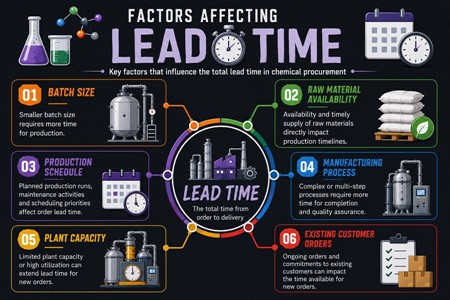
Production lead time can depend on:
-
Batch size
-
Production schedule
-
Raw material availability
-
Manufacturing process
-
Plant capacity
-
Existing customer orders
-
Required grade and specifications
For specialty or LR Grade chemicals, additional processing may also be required to achieve the desired specifications.
3. Quality Testing and Documentation
Chemical products often need to undergo quality checks before dispatch.
Depending on the product and customer's requirements, this may involve checking parameters such as:
-
Assay
-
Appearance
-
Purity
-
pH
-
Sulphate or chloride content
-
Heavy metals
-
Other product-specific specifications
Customers may also require a
Certificate of Analysis (CoA) or other quality documentation.
Consequently, quality control can form an important part of the overall lead time.
4. Packaging Requirements
Packaging requirements can also affect delivery schedules.
A standard 25 kg bag may be readily available, while customized packaging, labeling, batch identification, or special liner requirements may require additional preparation.
This is particularly relevant for
hygroscopic chemicals, where appropriate moisture-resistant packaging is important for maintaining product quality during storage and transportation.
5. Quantity Ordered
The size of the order can significantly influence lead time.
A small quantity may be available from existing inventory, whereas a large bulk order may require a dedicated production batch.
For example, a supplier may be able to immediately fulfill a smaller requirement from ready stock but require additional production time for a multi-tonne order.
6. Transportation
Even after the chemical has been manufactured, tested, and packed, transportation time must be considered.
Delivery time can depend on:
-
Dispatch location
-
Customer location
-
Transport availability
-
Shipment size
-
Mode of transportation
-
Road conditions
-
Holidays and peak logistics periods
Therefore,
production lead time and delivery lead time are not the same thing.
Understanding the Different Types of Lead Time
When discussing delivery schedules with chemical suppliers, it is useful to distinguish between different stages of lead time.
Production Lead Time
The time required to manufacture or process the chemical after receiving the order.
Quality Control Lead Time
The time required for testing, inspection, and preparation of quality documentation.
Packaging Lead Time
The time required to pack, label, and prepare the material for dispatch.
Transportation Lead Time
The time required for the shipment to travel from the supplier's facility to the customer's location.
Total Procurement Lead Time
This is the overall period covering the relevant stages from order placement to delivery.
Understanding these different stages makes it easier for buyers to identify where potential delays may occur.
Why Short Lead Times Matter
Shorter and more predictable lead times can provide several advantages to chemical buyers.
Reduced Production Disruptions
Manufacturers often depend on a continuous supply of raw materials. Delayed chemicals can potentially interrupt production schedules.
Lower Inventory Requirements
Reliable suppliers can allow companies to maintain more efficient inventory levels rather than holding excessive safety stock.
Better Customer Service
For repackers and distributors, predictable chemical availability makes it easier to fulfill customer orders on time.
Improved Cash Flow
Excess inventory ties up working capital. Better procurement planning can help businesses avoid purchasing significantly more material than they actually need.
Why the Cheapest Supplier May Not Always Be the Best Choice
Price is an important factor in chemical procurement, but it should not be considered in isolation.
Suppose Supplier A offers a chemical at a slightly lower price but requires three weeks for delivery, while Supplier B offers a slightly higher price but can dispatch from ready stock.
For a company facing an urgent production requirement, the second supplier may ultimately provide greater value.
The actual cost of procurement can include:
Product Price + Transportation + Inventory Cost + Delay Cost + Production Disruption Risk
This is why procurement teams should evaluate
total value and reliability, rather than focusing only on the quoted chemical price.
How Buyers Can Reduce Procurement Lead Times
Chemical buyers can take several steps to make procurement more predictable.
Plan Purchases in Advance
Avoid waiting until inventory reaches a critical level before placing an order. Historical consumption data can help determine when a new purchase should be initiated.
Discuss Lead Times Before Ordering
Ask suppliers about:
-
Current stock availability
-
Expected production time
-
Quality testing time
-
Packaging time
-
Dispatch schedule
-
Estimated transportation time
Getting clarity before placing the purchase order helps avoid misunderstandings later.
Develop Reliable Supplier Relationships
Long-term relationships with dependable suppliers can make procurement more predictable. Suppliers may also be better positioned to understand a customer's regular requirements and plan production accordingly.
Maintain Approved Alternative Suppliers
For critical chemicals, having an alternative qualified supplier can reduce dependency on a single source.
However, alternative suppliers should be evaluated and approved before an emergency occurs.
Share Forecasts With Suppliers
If a company has regular monthly or quarterly requirements, sharing an approximate forecast can help suppliers plan production and inventory.
This can be particularly useful for bulk chemical buyers.
Questions to Ask Your Chemical Supplier
Before placing an important chemical order, buyers should consider asking:
-
Is the material currently available in ready stock?
-
What quantity is available?
-
If production is required, what is the expected production time?
-
How long will quality testing take?
-
Will a CoA be provided?
-
What packaging is available?
-
What is the expected dispatch date?
-
What is the estimated transportation time?
-
Can the supplier handle repeat or bulk requirements?
-
What happens if the required quantity is needed urgently?
These questions can help procurement teams obtain a more realistic understanding of the actual delivery timeline.
The Importance of Reliable Chemical Suppliers
A dependable chemical supplier is not simply a company that offers a competitive quotation. Reliability also means
consistent quality, predictable lead times, proper packaging, adequate stock availability, and timely communication.
For businesses using chemicals as raw materials, these factors can have a direct impact on production planning and customer commitments.
Lead time is an important but sometimes overlooked factor in chemical procurement.
A competitive price is valuable, but
a competitively priced chemical that arrives late can become an expensive purchase. Understanding production, testing, packaging, and transportation lead times allows procurement teams to plan more effectively and minimize supply disruptions.
The best chemical procurement strategy is therefore not simply to find the lowest price—it is to find a supplier that offers the right combination of
quality, price, availability, reliability, and predictable delivery.
In a supply chain where every day can matter, understanding and managing chemical procurement lead times can give businesses a significant operational advantage.