In the chemical industry, compliance, classification, and clarity are just as important as quality and consistency. One of the most critical elements that supports smooth trade, taxation, and regulatory compliance is the
HSN number. Whether you are a manufacturer, trader, exporter, or importer of chemicals, understanding HSN codes is essential for hassle‑free operations.
This blog breaks down what HSN numbers are, why they matter in the chemical industry, and how common chemicals are classified under HSN.
What is an HSN Number?
HSN stands for
Harmonized System of Nomenclature. It is an internationally standardized system of naming and classifying goods, developed by the
World Customs Organization (WCO).
HSN codes are used globally for:
-
Classification of goods
-
Determination of GST and customs duties
-
Trade statistics
-
Import and export documentation
India adopted HSN under the GST regime to bring uniformity and transparency in taxation.
Structure of an HSN Code
An HSN code can have
2, 4, 6, or 8 digits, depending on the level of detail required:
-
First 2 digits – Chapter (broad category of goods)
-
Next 2 digits – Heading
-
Next 2 digits – Sub‑heading
-
Last 2 digits – National tariff item (India‑specific)
-
For most chemicals,
Chapter 28 and Chapter 29 are the most relevant.
Importance of HSN Codes in the Chemical Industry
The chemical industry deals with a wide variety of substances—organic, inorganic, hazardous, non‑hazardous, intermediates, and specialty chemicals. Correct HSN classification is crucial because:
-
GST rates depend on HSN codes
-
Ensures accurate invoicing and tax compliance
-
Avoids penalties, audits, and disputes
-
Facilitates smooth import/export clearance
-
Helps customers and regulators clearly identify products
A minor misclassification can lead to incorrect tax rates or regulatory complications.
Major HSN Chapters Relevant to Chemicals
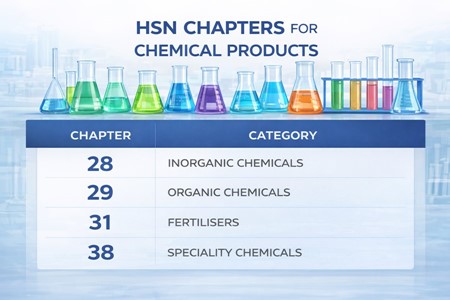
Chapter 28 – Inorganic Chemicals
Covers inorganic chemicals such as:
-
Acids and salts
-
Oxides and hydroxides
-
Carbonates and phosphates
Examples:
-
Di Ammonium Phosphate (LR Grade) – HSN 2835
Chapter 29 – Organic Chemicals
Includes:
-
Organic acids and their derivatives
-
Alcohols, phenols
-
Amines, esters, and salts
Examples:
-
Ammonium Acetate – HSN 2915
-
Sodium Oxalate – HSN 2917
Chapter 31 – Fertilizers
Applicable to chemicals used primarily as fertilizers:
-
Mono Ammonium Phosphate (MAP)
-
Di Ammonium Phosphate (DAP)
Example:
-
Di Ammonium Phosphate – HSN 3105
Chapter 38 – Specialty & Industrial Chemicals
Covers prepared binders, chemical products, and mixtures not specified elsewhere:
-
Specialty chemicals
-
Industrial formulations
-
Chemical preparations
HSN Codes & GST in the Chemical Industry
Under GST, the number of digits required depends on turnover:
-
Businesses with turnover up to ₹5 crore – 4‑digit HSN (optional for B2C)
-
Businesses with turnover above ₹5 crore – 6‑digit HSN mandatory
-
Exporters – 8‑digit HSN required
Most chemicals fall under
GST slabs of 18%, though some may be taxed at 5% or 12% depending on usage and classification.
Common Challenges in Chemical HSN Classification
-
Similar chemicals falling under different chapters
-
Differences between technical grade, LR grade, and pharmaceutical grade
-
Multi‑use chemicals (industrial vs pharma vs fertilizer)
-
Constant updates and clarifications by GST authorities
To avoid errors, it is always advisable to:
-
Refer to the latest GST tariff notifications
-
Consult a tax professional or classification expert
-
Maintain proper product specifications and MSDS
Best Practices for Chemical Manufacturers & Traders
-
Clearly mention HSN code on invoices and quotations
-
Maintain product‑wise HSN master data
-
Train accounts and dispatch teams on correct classification
-
Re‑validate HSN codes when launching new products
-
Keep documentation ready for audits and inspections
Conclusion
HSN numbers play a vital role in ensuring transparency, compliance, and efficiency in the chemical industry. With the vast range of chemicals and applications involved, correct classification is not just a statutory requirement—it is a business necessity.
For chemical manufacturers, traders, and exporters, investing time in understanding and applying the right HSN codes can prevent costly mistakes and build trust with customers and authorities alike.
If you deal in LR grade chemicals, specialty chemicals, or chemical intermediates, staying updated with HSN classifications will keep your operations smooth and compliant.