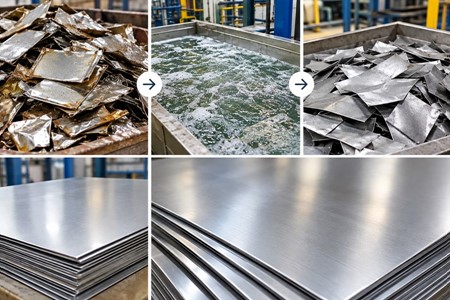
Tin-coated steel is widely used in applications such as food cans, packaging materials and industrial components. While the thin layer of tin provides corrosion resistance and other desirable properties, there are situations where this coating needs to be removed. The process of removing tin from an iron or steel surface is known as
detinning.
One chemical that has been used in specialized detinning processes is
Ammonium Oxalate. Its role is particularly associated with electrolytic and chemical processes involving the removal or treatment of tin coatings.
What Is Detinning?
Detinning is the process of separating or removing a tin coating from an underlying metal, usually iron or steel.
A common example is
tinplate, which consists of:
Tin coating → Steel or iron base
When tinplate scrap is generated during manufacturing or collected after use, the tin and steel may be separated for recycling and recovery. This can help recover valuable tin while allowing the remaining steel to be further processed or recycled.
The Role of Ammonium Oxalate
Ammonium Oxalate can be used in specialized
electrolytic detinning processes as part of an oxalate-based electrolyte.
In a simplified process:
Tin-coated iron or steel
↓
Placed in an ammonium oxalate-containing electrolyte
↓
Electrical current is applied under controlled conditions
↓
Tin coating is removed from the steel surface
↓
Tin and steel can be processed separately
The exact composition of the electrolyte, electrical conditions, temperature and process design depend on the specific industrial application.
Why Is Oxalate Chemistry Useful?
The oxalate ion has the ability to interact with metal ions and form metal-oxalate complexes. This property makes oxalate-based chemistry useful in certain analytical, electrochemical and metal-treatment applications.
During a detinning process, the objective is to remove the tin coating efficiently while minimizing damage to the underlying iron or steel. In an appropriately designed electrolytic system, an oxalate-containing solution can assist in the electrochemical handling of tin.
However, it is important to note that Ammonium Oxalate is not simply applied to a tin-coated surface like a conventional stripping chemical. Its role is dependent on the specific process chemistry and, in specialized applications, the use of electrolysis.
A Simplified View of the Process
The overall concept can be represented as:
Tinplate or Tin-Coated Steel Scrap
↓
Pre-treatment and cleaning
↓
Electrolytic treatment using a suitable electrolyte
↓
Tin coating removed from the steel surface
↓
Recovery or further processing of tin
↓
Remaining steel sent for recycling
Ammonium Oxalate may be used where an
oxalate-based electrolyte system is suitable for the process.
Applications in Tin Recovery and Recycling
Detinning can be relevant in the recycling of materials such as:
-
Tinplate manufacturing scrap
-
Tin punching scrap
-
Tin-coated steel offcuts
-
Certain tin-containing industrial scrap
-
Used tin-coated metal products
Removing and recovering tin can add value to scrap material, particularly when both the tin and the underlying steel can be recovered or reused.
Detinning Methods Can Vary
It is important to understand that
not all detinning operations use Ammonium Oxalate.
Different companies and recycling facilities may use:
-
Alkaline chemical processes
-
Caustic soda-based systems
-
Electrolytic detinning
-
Other proprietary chemical formulations
Therefore, a company involved in tin recycling should not automatically be assumed to be a user of Ammonium Oxalate.
Instead, Ammonium Oxalate should be considered a
specialized chemical option for suitable detinning and metal-treatment processes.
Why High-Purity Ammonium Oxalate Matters
Where Ammonium Oxalate is used in controlled chemical or electrolytic applications, consistency and purity can be important.
Impurities in a chemical can potentially affect:
-
Electrolyte performance
-
Process consistency
-
Metal recovery efficiency
-
Formation of unwanted deposits
-
Overall product quality
For this reason, manufacturers and process operators may prefer a consistent grade of Ammonium Oxalate with reliable specifications.
Conclusion
Detinning is an important process in the treatment and recycling of tin-coated iron and steel. In specialized electrolytic processes,
Ammonium Oxalate can be used as part of an oxalate-based electrolyte system for the removal and treatment of tin coatings.
However, detinning technology is not standardized around a single chemical. Different operations may use alkaline, electrolytic or other chemical systems depending on their equipment and process requirements.
For manufacturers and suppliers of high-quality Ammonium Oxalate, the detinning industry represents a
specialized and potentially valuable application area. The best approach is to work with metal recyclers, tin recovery companies and surface-treatment specialists to understand their existing process chemistry and determine whether an oxalate-based system is suitable.
Sampan Enterprises manufactures and supplies LR Grade Ammonium Oxalate for laboratory, chemical and specialized industrial applications.