In the chemical industry, even a small difference in a product's chemical composition can have a significant impact on its performance, application and suitability for a particular process.
One such distinction is whether a chemical is available in its
dihydrate or anhydrous form.
Many chemicals are commercially available in both forms. Although they may share the same basic chemical identity, the presence or absence of water molecules in their crystal structure changes their molecular weight, chemical composition and certain physical properties.
Understanding this difference is important for chemical manufacturers, industrial buyers, laboratory professionals and procurement teams.
1. What is Anhydrous?
The term
anhydrous means without water.
An anhydrous chemical is a compound that does not contain water of crystallisation as part of its crystal structure.
These compounds contain no fixed water molecules in their chemical formula.
For example:
-
Anhydrous Oxalic Acid (C₂H₂O₄)
Anhydrous forms are particularly relevant in applications where the presence of water needs to be minimised or controlled.
2. What is Dihydrate?
The term
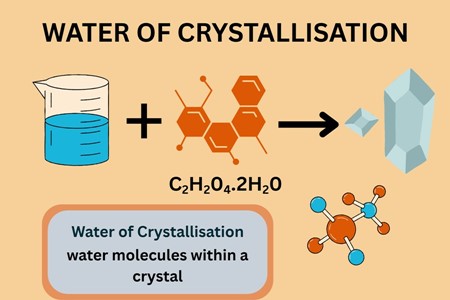
dihydrate refers to a chemical compound that contains two molecules of water for every molecule of the main compound.
This water is known as
water of crystallisation and is incorporated into the crystal structure of the compound.
The water is not simply moisture present on the surface of the chemical. It forms part of the compound's crystalline structure.
For example:
-
Oxalic Acid Dihydrate (C₂H₂O₄·2H₂O)
Depending on the compound, water of crystallisation can influence its molecular weight, crystal structure, solubility and thermal behaviour.
3. Key differences between dihydrate and anhydrous chemicals
Although both forms contain the same underlying chemical compound, their properties can differ.
|
Parameter |
Anhydrous |
Dihydrate |
|
Water content |
No water of crystallisation |
Two water molecules per formula unit |
|
Chemical formula |
Does not include water molecules |
Includes 2H₂O |
|
Molecular weight |
Lower |
Higher |
|
Active compound per unit weight |
Generally higher |
Lower due to crystal water |
|
Crystal structure |
Anhydrous crystal form |
Hydrated crystal form |
|
Applications |
Preferred where water must be minimised |
Suitable where the hydrated form is specified |
It is important to remember that the differences in physical properties and performance depend on the particular chemical. Dihydrate and anhydrous forms should not automatically be considered interchangeable.
4. Example: Oxalic Acid Dihydrate vs Anhydrous Oxalic Acid
Oxalic Acid is an excellent example to understand the difference between the two forms.
It is commercially available as:
Oxalic Acid Dihydrate
-
Chemical Formula: C₂H₂O₄·2H₂O
-
Molecular Weight: 126.07 g/mol
-
CAS Number: 6153-56-6
Anhydrous Oxalic Acid
-
Chemical Formula: C₂H₂O₄
-
Molecular Weight: 90.03 g/mol
-
CAS Number: 144-62-7
The difference in molecular weight arises from the two water molecules present in Oxalic Acid Dihydrate.
Let's understand what this means in practical terms.
The molecular weight of Oxalic Acid Dihydrate is approximately 126.07 g/mol, of which 36.03 g/mol represents water of crystallisation.
Therefore:
-
Oxalic Acid content = 71.42%
-
Water of crystallisation = 28.58%
This means that 100 kg of pure Oxalic Acid Dihydrate contains approximately 71.42 kg of Oxalic Acid equivalent and 28.58 kg of water of crystallisation.
In comparison, 100 kg of pure anhydrous Oxalic Acid contains 100 kg of Oxalic Acid.
Why does this matter?
Suppose an industrial process requires a specific quantity of Oxalic Acid on an anhydrous basis. Using the dihydrate form without adjusting the quantity can result in an incorrect dosage.
The buyer must account for the water of crystallisation when calculating the required quantity.
This is particularly important in chemical formulations, quantitative laboratory work and processes where precise chemical concentrations are essential.
5. Does dihydrate mean lower purity?
This is one of the most common misconceptions among chemical buyers.
The answer is
no.
A dihydrate chemical is not necessarily less pure than its anhydrous counterpart.
Water of crystallisation is a defined part of the chemical's composition. It is not automatically considered an impurity.
For example, Oxalic Acid Dihydrate can have a high assay value while still containing approximately 28.58% water of crystallisation.
The reported assay and purity must be interpreted according to the applicable specification and analytical method.
Buyers should also distinguish between:
-
Assay on an as-is basis.
-
Assay on a dried basis.
-
Water content or loss on drying.
-
Impurity levels specified in the Certificate of Analysis (COA).
Therefore, comparing two chemicals based only on their assay percentages, without checking their hydration state and testing basis, can be misleading.
6. Can dihydrate chemicals be converted into anhydrous chemicals?
In certain cases, yes.
Some hydrated compounds can be converted into their anhydrous forms through controlled heating or other dehydration processes.
During this process, water of crystallisation is removed from the crystal structure.
7. How should buyers choose between dihydrate and anhydrous chemicals?
Selecting the right form depends primarily on the intended application and process requirements.
Before purchasing a chemical, buyers should consider the following:
1. Application requirements
Check whether the manufacturing process or laboratory procedure specifically requires the anhydrous or hydrated form.
2. Chemical composition
Verify the molecular formula and CAS number to ensure that the correct form is being purchased.
3. Dosage calculations
Account for the difference in molecular weight and active compound content when calculating the required quantity.
4. Purity specifications
Review the COA to understand the assay, moisture content and impurity limits.
5. Storage and handling
Check the recommended storage conditions. Certain anhydrous chemicals readily absorb atmospheric moisture, while some hydrated chemicals can lose water under unsuitable conditions.
6. Commercial considerations
Compare the cost based on the actual quantity of active chemical supplied rather than simply comparing the price per kilogram.
8. Conclusion
The distinction between dihydrate and anhydrous chemicals goes beyond the presence or absence of water.
Water of crystallisation is an integral part of a hydrated compound's chemical composition and can influence its molecular weight, physical properties and suitability for different applications.
For chemical manufacturers and industrial buyers, understanding this distinction helps ensure accurate procurement, appropriate dosage calculations and consistent process performance.
At the time of purchasing chemicals, always verify the chemical formula, CAS number, grade and relevant specifications to ensure that you receive the correct product for your application.
At Sampan Enterprises, we believe that understanding product specifications is just as important as maintaining product quality. We manufacture and supply LR Grade chemicals with a focus on consistent quality, reliable supply and efficient customer service.
For product enquiries and specifications, get in touch with Sampan Enterprises.
Sampan Enterprises – We make the products that you desire & the quality that you deserve.